Leadership training where people practise the coaching conversation, not just hear about it
In a workshop, the facilitator carries the practice. Take that away, and most conversions become just slides and video.
Breville’s Global Product team ran High Performing Squads, a leadership and team-effectiveness programme, as live workshops in person and over Zoom. They wanted it self-paced: a refresher for people who attended, and a way in for new team members who never would. Working from the facilitator’s slides, the session recordings and participant feedback, I matched each part to the tool that suited it: Rise for the ideas, and Storyline scenario-based learning for the coaching decisions.
Sole Instructional Designer · 3 workshops · Rise + Storyline · No LMS

At a glance
- Client
- Breville, Global Product L&D
- Audience
- People who attended the live workshops (a refresher) and new team members who never did (the full experience)
- My role
- Designed the conversion and built the Rise courses and the Storyline coaching scenario
- Delivered
- Self-paced courses published as web versions on SharePoint. The web version's assessment was a SurveyMonkey questionnaire, later replaced when Breville moved to Cornerstone LMS.
- Tools
- Articulate Rise · Articulate Storyline · SurveyMonkey · Canva · Adobe Creative Cloud · SharePoint
The live workshops worked. The question was what would stop working once the facilitator was gone.
The facilitator carried the engagement
In the room, a person held attention, asked the questions and kept the discussion going. A straight conversion loses all of that.
Two kinds of learning in one programme
Some sessions were about ideas to understand. The coaching session was about judgement: what to say, and when. One format would serve one well and the other badly.
The live sessions held real signal
Participants had said what landed and what didn’t. A straight conversion would copy the slides and ignore that feedback.
Two audiences, one course
The same course had to work as a refresher for people who attended the workshops, and as the full experience for new team members who never would.
The challenge
Make a facilitator-led leadership programme work without a facilitator, and make it better, not just digital.
Limits: the only source material was slides, recordings and feedback, and the courses had to run for every team member without a trainer to book.
That raised three design questions:
How do people practise a coaching conversation with nobody to practise with?
What format does each part of the programme actually need?
How do you keep what worked live, and fix what didn’t?
Four decisions. The first is the heart of the programme.
1. Practise the coaching decisions through scenario-based learning
A scenario gives every learner the practice partner the workshop used to provide.
Learners coach a team member through a realistic situation, choosing what to say at each step.
Three coaching decisions, with feedback on why each choice helps or hurts the conversation. Built in Storyline, scenario-based learning that Rise can’t do.
2. Match the tool to what each part has to do
Forcing a whole programme through one tool is where conversions lose the learning.
Rise: for the knowledge sessions, such as thinking styles, where understanding is the goal and a clear, linear path fits.
Storyline: for the coaching session, where learners make decisions and practise them in a scenario.
3. Use the live feedback to decide what to keep, cut or strengthen
The self-paced version improved on the live one, instead of just copying it.
Reviewed: participant feedback from the live sessions, alongside the recordings and slides.
Decided: what made it into the self-paced version, what was cut, and what needed strengthening.
Kept listening: post-workshop feedback questionnaires in SurveyMonkey.
4. Design the engagement back in
Without a facilitator, attention has to be earned by what the learner does.
Interaction in place of presence: scenario decisions with named characters, drag-and-drop and dial interactions, and knowledge checks.
Visuals that make the point: custom visuals built on metaphor, such as a forest performance review that rates a fish on climbing, a rabbit on flying and an eagle on swimming.
Facilitator presence kept: not Zoom clips, but the sessions rebuilt for the solo learner. Each idea in the visual it needs: AI scenes for the metaphors, whiteboard for the concepts, Vyond explainers for the character-based scenes.
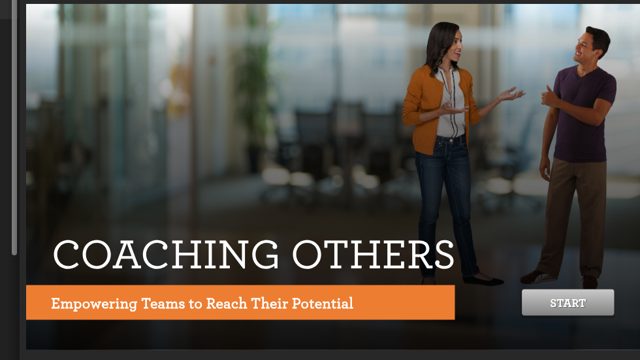
Coaching Practice: Make the coaching calls yourself through scenario-based learning built in Articulate Storyline.
Knowledge Companion: Try the knowledge section of the programme. Clear, linear, and interactive, built in Articulate Rise.
Two audiences, one course
A refresher for people who attended, and a way in for new team members who never would.
Coaching practice with feedback
Learners practise coaching calls through scenario-based learning, with feedback on each choice.
The right tool for each part
Rise for the ideas, Storyline for the decisions.
Engagement by design
Interactions and metaphor-led visuals do the work the facilitator used to do.
Need leadership or people-skills training that people can actually practise?
Tell me about the programme and how it runs now. I’ll tell you how I’d make it work without a facilitator in the room.
Available remotely for projects, contracts and roles.